
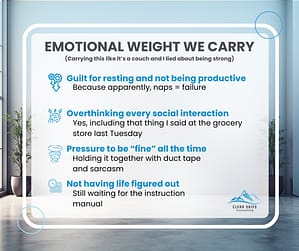

Feeling worn down after carrying emotional responsibility for a long time is a human response, not a personal failure. Heaviness often shows up when you care deeply and show up consistently. You are allowed to put some of the weight down and you do not have to hold everything alone.
Understanding Emotional Responsibility
Emotional responsibility can look like being the steady one in your family, the friend who always listens, or the coworker people turn to when things get complicated. You might mediate conflicts, soothe tension, and notice what others need before they say a word. Over time, that kind of care becomes a quiet job you never applied for, and it can feel like you are always on.
Many people learn this role early to keep relationships safe and stable. It can be a skill that once protected you or helped your group function. The challenge is that skills that work in one season can become exhausting in another, especially without space to recharge or share the load.
Heaviness Is Not Failure
Feeling heavy is often your nervous system saying it needs rest, not proof that you are weak. Emotional labor demands energy, attention, and time, and even the most compassionate person has limits. When your body signals fatigue, it is offering information you can use to care for yourself with the same kindness you offer others.
Think of heaviness like a muscle that has been working without a cool down. Rest does not undo your strength or your care. It keeps both available for the moments that truly need them.
Signs You Might Be Carrying Too Much
Over-carrying often shows up as irritability, a shorter fuse, or numbness where you once felt patient. You might notice overthinking, a sense of dread before conversations, or a tightness in your chest that does not fully release. Sleep can shift too, either from staying up late to get quiet time or waking in the night with looping thoughts.
It can also look like saying yes out of habit, then feeling resentment you do not want to feel. Maybe you replay interactions to make sure you did not upset anyone, yet still feel responsible for their mood. These are signals that your inner caretaker needs care as well.
Letting Some Weight Down
One gentle step is to name what you feel out loud, even if only to yourself. Try a simple sentence like, I am feeling burdened and I need a pause. Naming creates space between you and the load, and that space makes choice possible. You might then share a small truth with someone you trust, like, I want to be there for you and I also need time to recharge tonight.
Right-sizing responsibility can help too. Ask yourself what is genuinely yours in a situation and what belongs to others. If a friend is upset, you can listen with care while allowing them to hold their choices and outcomes. A small experiment might be delaying your response for a few hours so you can check in with your needs before you jump in.
Asking for Help Without Guilt
Support works best when it is specific and timed. Instead of I need help, try, Could you call me after work today so I can process something for 10 minutes. Let people know what would actually help and what is off limits right now. Being clear does not burden others, it gives them a real chance to show up well.
Creating Sustainable Support
Build tiny, reliable moments of relief into your day-to-day life. Short walks, light stretching, or a few steady breaths with a longer exhale can settle a stirred-up system. Try a brief check-in at midday to ask, What am I carrying that is not mine, and what can I set down for now.
Community care can be just as powerful. Create rotating roles in your family or group so that you are not always the one who reaches out or plans. Schedule regular check-ins that are mutual rather than one sided. Make room for small joys that restore you, like music, a hobby, or quiet time that belongs to you alone.
When Professional Support Helps
If heaviness sticks around for weeks, if you feel persistently overwhelmed, or if old patterns keep pulling you back, a therapist or counselor can help you untangle what is yours to hold. Therapy offers a structured place to practice boundaries, examine beliefs about responsibility, and build new skills for shared care. The right fit should feel respectful, collaborative, and centered on your goals.
You are not failing because you feel tired. You are noticing that you have been strong for a long time and your system is asking for care. Small steps count, and sharing the load can make space for relief, clarity, and steadier compassion for you and the people you love.